

close
Choose Your Site
Global
Social Media
Views: 0 Author: Site Editor Publish Time: 2026-10-05 Origin: Site


Heavy equipment acquisition demands serious capital expenditure from any business. Buying the wrong machine size quickly drains project budgets and limits future growth. Choosing an incorrect track type creates immediate operational headaches on complex job sites. A mismatched excavator causes bloated transport expenses and burns excessive daily fuel. It also lacks the required breakout force for tough digging operations. You need an optimal balance of raw power and site mobility. This precise balance keeps your earthmoving projects highly profitable and on schedule. The 25-ton class hits a universally known sweet spot in construction. Contractors use it extensively for mid-to-large civil and commercial developments. It balances heavy digging capability against highly manageable daily logistics. This guide evaluates crawler models against wheeled, smaller, and larger alternatives. We use a strict ROI and operational capability framework. This approach strips away misleading marketing claims entirely. You will learn exactly how to size your next machine correctly. You can then make confident, profitable purchasing decisions for your heavy fleet.
Optimal Use Case: A 25 ton crawler excavator excels in raw earthmoving, deep trenching, and rocky terrain where stability and breakout force trump rapid site-to-site mobility.
The Mobility Trade-off: Wheeled excavators outperform 25-ton crawlers only on finished surfaces (urban paving, utilities) but sacrifice lifting capacity and traction.
Sizing Logic: Upsizing to a 30-ton+ machine triggers exponential transport costs (permits/lowboys); downsizing to 20-ton risks cycle-time delays on high-volume material removal.
Acquisition Strategy: Evaluating the total lifecycle cost—not just the initial crawler excavator price—dictates whether to buy new, lease, or source a used crawler excavator.
Every contractor needs reliable specifications before investing heavy capital. A standard 25 Ton Crawler Excavator delivers robust baseline metrics for serious work. You can expect reliable engine outputs ranging between 170 and 190 horsepower. These machines typically feature a standard bucket capacity spanning 1.0 to 1.3 cubic meters. They also offer impressive maximum digging depths designed specifically for deep trenching tasks. This power profile ensures consistent cycle times during mass excavation phases.
Steel tracks define the harsh operational reality of these heavy units. Tracks distribute the massive machine weight across a very large surface area. This lowers overall ground pressure significantly compared to pneumatic tires. You get superior traction in thick mud and loose sand. Operators can safely navigate steep gradients and highly uneven terrain. Wheeled models simply cannot match this aggressive terrain capability. The undercarriage design provides a highly stable anchor during heavy pulling operations.
However, this impressive power comes alongside specific primary limitations. The most obvious drawback involves very slow travel speed. You will generally move under 3.5 mph across a job site. This makes long distance tramming highly inefficient and time-consuming. Furthermore, steel tracks cause severe damage to finished concrete and asphalt surfaces. You must keep them strictly on dirt or deploy heavy protective mats. Moving them across public roads always requires a dedicated transport trailer.
Scalability remains a major advantage for the 25-ton weight class. These machines provide exceptional auxiliary hydraulic flow capabilities. They easily run heavy-duty attachments like hydraulic hammers, shears, and concrete pulverizers. You can transform a standard digger into a versatile demolition tool quickly. Fleet managers love this adaptability for changing project phases. It maximizes overall machine utilization across different contracting jobs.
Specification Category | Average Market Range | Operational Impact |
|---|---|---|
Engine Output | 170 – 190 HP | Provides sufficient torque for multi-function hydraulic demands. |
Standard Bucket Capacity | 1.0 – 1.3 cubic meters | Optimizes pass-matching for loading standard articulated dump trucks. |
Maximum Digging Depth | 21 – 23 feet | Enables deep utility trenching without frequent repositioning. |
Travel Speed | 2.0 – 3.5 mph | Requires strategic site planning to minimize dead-tramming time. |
Choosing between tracks and wheels dictates your site mobility entirely. Wheeled units provide high travel speeds reaching up to 20 mph. You can drive them directly between urban job sites quickly. They do not require a separate transport trailer for short municipal jumps. This independence reduces daily logistical bottlenecks significantly. However, they sacrifice critical lifting stability to achieve this road speed.
Crawler models offer vastly superior 360-degree lifting capacity. Their wide track footprint creates a much lower center of gravity. You get unmatched stability during heavy lifts over the side of the machine. This makes crawlers mandatory for greenfield development and forestry work. They also dominate in aggressive quarry environments requiring maximum breakout force. Wheeled units fit much better into municipal street maintenance tasks where surface preservation matters most.
The operational environment always dictates the correct machine choice. Soft soils easily swallow wheeled excavators. The concentrated weight on four pneumatic tires causes immediate sinking in wet clay. Conversely, triple grouser track shoes grip loose material firmly. They propel the machine forward through terrible weather conditions. You must analyze your most common ground conditions before purchasing either design.
Maintenance requirements diverge sharply between these two fundamental designs. Wheeled excavators primarily need occasional pneumatic tire replacements and axle servicing. Crawler models demand highly complex undercarriage rebuilds eventually. You must budget for replacing sprockets, idlers, rollers, and track chains over time. These rebuild costs require careful financial planning to avoid sudden cash flow crunches. A snapped track chain stops production instantly until repaired.
Feature | Wheeled Excavator | Crawler Excavator |
|---|---|---|
Travel Speed | Up to 20 mph (Street Legal in some areas) | Under 3.5 mph |
Lifting Stability | Moderate (Requires deploying outriggers) | Excellent (360-degree native stability) |
Ideal Terrain | Asphalt, concrete, packed gravel | Mud, sand, shot rock, steep hills |
Maintenance Focus | Tires, axles, outrigger cylinders | Sprockets, idlers, track chains, tensioners |
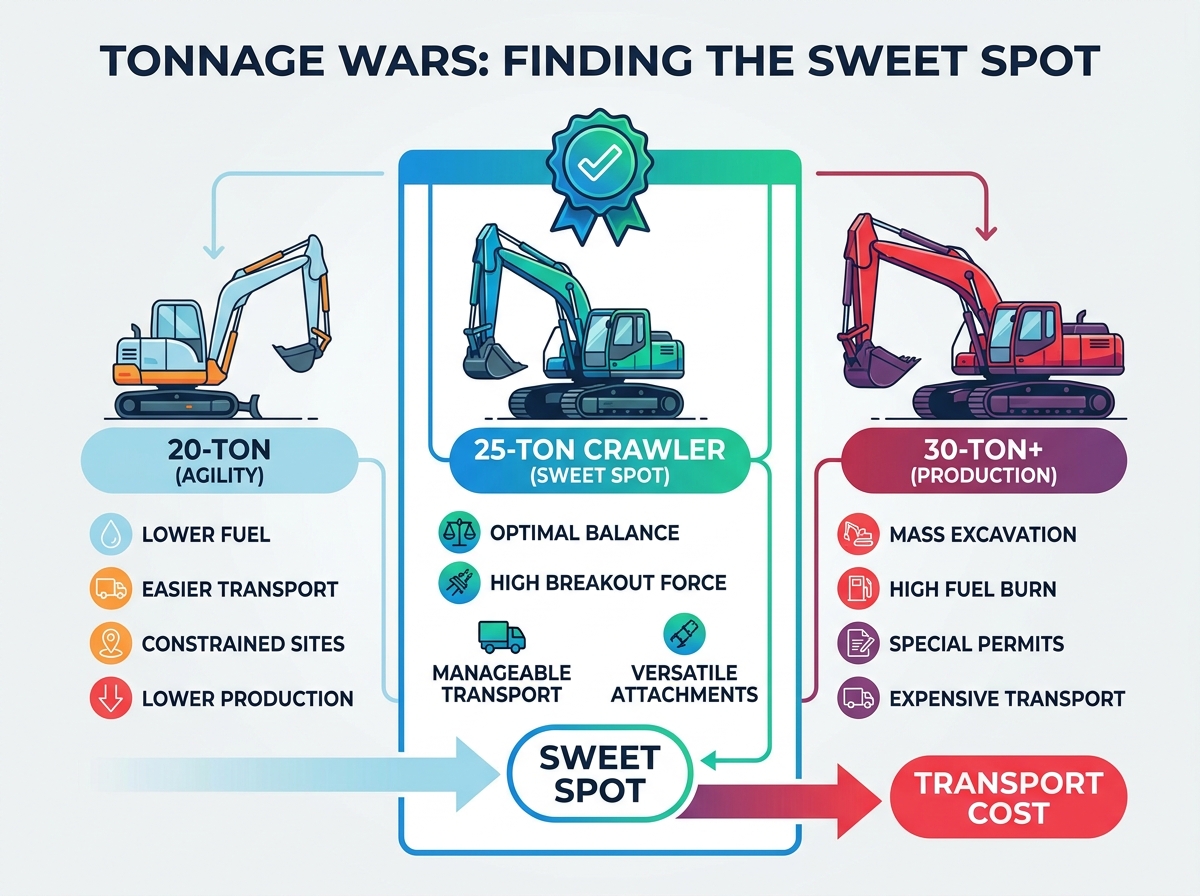
Contractors frequently debate the exact tonnage needed for optimal efficiency. We call this ongoing industry debate the tonnage war. You must match the machine size directly to your primary daily workload. Buying too much machine wastes fuel. Buying too little machine delays project completion times.
The 20-ton model represents the pure agility play. It offers notably lower fuel consumption and much easier transport logistics. You should select this size when site space feels highly constrained. Residential developments often demand this tighter swing radius. However, it may struggle significantly against dense clay or rocky materials. Operators often experience slower cycle times during high-volume material removal.
The 25-ton category acts as the perfect operational sweet spot. It provides robust breakout force for dense clay and shot rock. You get this immense power without crossing into oversized transport regulations in many regions. Most jurisdictions allow standard heavy-haul transport for this exact weight class. You avoid the nightmare of securing special wide-load permits for every single move. It perfectly bridges the gap between agility and raw strength.
Stepping up to 30-ton machines and beyond becomes a pure production play. You absolutely need these giants for mass excavation and heavy quarry loading. Unfortunately, they require specialized permits and dedicated multi-axle low-boy trailers. They also consume significantly more fuel per hour of operation. You must have enough dump trucks running to keep these large machines busy. Otherwise, they sit idle and drain your daily profit margins.
Smart fleet managers often utilize a creative combo strategy. You can easily pair a 25-ton unit alongside a nimble mini excavator. This pairing yields better overall site efficiency on complex jobs. It often outperforms purchasing a single massive 35-ton machine. The larger unit handles the heavy bulk earthmoving. The smaller unit finishes the delicate grading and tight trenching work. You gain ultimate flexibility to handle diverse tasks simultaneously.
Capital expenditure demands intense scrutiny during the initial procurement phase. You must break down the average new crawler excavator price carefully before committing funds. Initial acquisition costs vary wildly based on built-in technology tiers. Standard models offer reliable performance at a highly predictable baseline cost. However, units equipped featuring factory GPS or 3D-grade control systems command significant premium prices. These expensive tech upgrades often drive faster ROI through vastly improved grading accuracy and reduced material rework.
Many buyers debate the merits of the secondary equipment market. You should actively look for a reliable used crawler excavator when seeking a backup fleet addition. Low annual hour machines offer excellent value for growing contractors. Conversely, you should generally buy new for your primary frontline production machine. The comprehensive factory warranty prevents disastrous downtime on critical path projects. Unplanned engine failures on a primary digger can bankrupt a small contracting business quickly.
Navigating the secondary machinery market requires strict physical inspection protocols. You must watch for specific mechanical red flags when evaluating any crawler excavator for sale. Inspect the undercarriage wear percentages meticulously using specialized measurement tools. Listen closely for high-pitched hydraulic pump whine during operation. You should also check for excessive slew ring play before making a final financial offer. Taking oil samples provides deep insights into internal engine health.
Operating expenditures directly impact your daily project profitability. You must factor in modern fuel efficiency work modes and daily DEF consumption. Diesel exhaust fluid adds a recurring cost to all modern diesel engines. Furthermore, planned undercarriage wear remains a massive operational cost driver. Proactive financial planning keeps these daily and monthly expenses manageable. Finding a certified used crawler excavator through reputable dealer networks minimizes unexpected repair bills down the road. You secure peace of mind alongside a lower initial purchase price.
Making the final purchase requires a highly structured decision process. Emotion should never drive heavy equipment acquisition. We recommend a strict four-step framework to finalize your equipment shortlist. This ensures you purchase the exact machine your field teams actually need.
Step 1: Audit Site Constraints. You must verify local transport weight limits first. Calculate your required turning radius on typical job sites. You must also check maximum allowable ground bearing pressure requirements.
Step 2: Material and Volume. Match your required breakout force directly to the primary material density. Loose topsoil demands different bucket sizes compared to heavy blasted rock. Calculate your target daily cubic yardage to ensure the machine keeps pace.
Step 3: Attachment Ecosystem. Check your auxiliary hydraulic specifications closely. Ensure the flow rates and pressure ratings match your existing fleet of attachments perfectly. Replacing perfectly good hammers simply because they do not fit the new machine wastes money.
Step 4: Implementation Risks. Factor in your local dealer proximity and spare parts availability. Fast dealer response times save projects during breakdowns. Additionally, operator familiarity regarding the brand's cab layout heavily impacts daily productivity.
Following these exact steps removes guesswork from the buying process. You ensure the machine aligns perfectly against your true operational reality. A methodical approach prevents costly sizing errors and ensures immediate site productivity upon delivery.
The 25-ton crawler remains an industry staple for excellent reasons. It offers the best possible ratio of raw digging power to daily transportability. Contractors worldwide rely on its incredible versatility across countless applications. It bridges the gap between nimble utility machines and massive mining excavators.
We strongly recommend avoiding purchases based strictly on the lowest sticker price. You must evaluate your specific soil conditions and daily transport logistics beforehand. Always double-check your hydraulic attachment compatibility before signing a purchase contract. A cheaper machine becomes wildly expensive if it cannot run your existing tools.
Take immediate action to validate your final equipment choice. Use the following action steps to move forward confidently:
Consult your local equipment dealer to request a site-specific demonstration.
Calculate your fully loaded transport costs based on local heavy-haul permit regulations.
Audit your existing attachment fleet to verify hydraulic flow requirements.
Browse the used market only after establishing firm technical parameters and budgets.
A: It depends strictly on your local DOT regulations. This specific weight class usually requires a specialized heavy-haul lowboy trailer. It often sits right on the borderline for wide-load or heavy transport permits. Always check state and municipal hauling laws before moving the machine to avoid severe fines.
A: A standard steel undercarriage averages between 4,000 and 5,000 operating hours. Your specific job site terrain dictates actual longevity. Highly abrasive materials like wet sand and sharp rock accelerate track wear significantly. Working primarily on soft loam extends the overall component lifespan drastically.
A: Your decision depends entirely on expected utilization rates. High-production earthmoving needs strongly favor the used 25-ton machine. It provides vastly superior breakout force. Conversely, projects requiring high reliability and low maintenance costs favor the brand new 20-ton unit backed by a full warranty.
A: Yes, it easily runs a wide variety of standard heavy attachments. However, you must carefully match the quick coupler or pin grabber size. You also need to verify the machine's auxiliary hydraulic flow rates. These specifications must align perfectly to operate the specific tool safely and efficiently.


