

close
Choose Your Site
Global
Social Media
Views: 0 Author: Site Editor Publish Time: 2026-10-01 Origin: Site


Purchasing a 20-ton excavator balances serious digging power with transportability. Buying used introduces significant mechanical and financial variables. You need heavy equipment ready for demanding jobs. Unexpected downtime ruins project profitability quickly. Failing to align machine specifications with primary job site requirements causes massive delays. Missing hidden wear during your inspection turns initial cost savings into a massive maintenance liability. These errors directly impact your daily operations and bottom line.
This guide provides a reliable framework. We will help you evaluate equipment capabilities accurately. You will learn how to inspect critical components like hydraulic pumps and swing motors. We outline clear strategies to shortlist the right equipment for your growing fleet. Follow these steps to make a confident, data-driven purchasing decision.
A 20-ton used excavator is the industry standard for medium-to-heavy earthmoving, offering a balance of breakout force and standard flatbed transportability.
Match boom, stick length, and auxiliary hydraulics to your primary tasks (e.g., trenching vs. demolition) before evaluating brands.
Undercarriage condition and hydraulic pump health dictate the true total cost of ownership; structural repairs can quickly negate initial purchase savings.
Always require fluid analysis and maintenance logs when evaluating used excavators for sale to verify hour-meter accuracy.
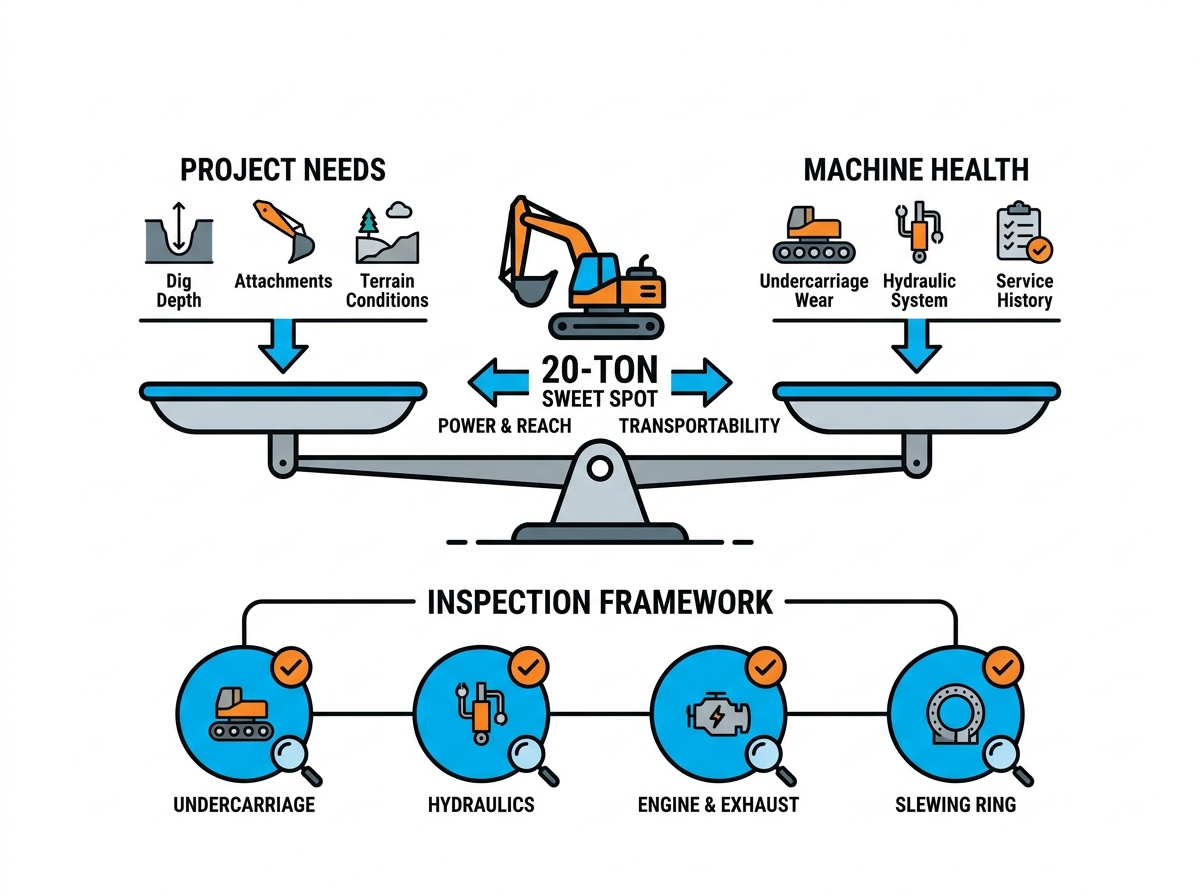
You must clearly define your project scope before browsing listings. The 20-metric-ton class dominates the construction industry for good reasons. It strikes the perfect operational sweet spot. Contractors consistently choose this weight category over 15-ton or 30-ton alternatives. A 15-ton machine often lacks the necessary breakout force for heavy trenching. A 30-ton excavator provides immense power but introduces logistical nightmares. Large machines typically require expensive oversized transport permits. Moving them between urban job sites becomes incredibly costly. The 20-ton tier offers maximum site versatility. It fits on standard lowboy trailers. It delivers enough lifting capacity for heavy concrete pipes. When evaluating a 20 ton used Excavator, you must match its exact physical configuration to your daily workload.
Excavator front linkages dictate your working limits. Do not ignore boom and stick measurements. Standard reach configurations handle most utility trenching tasks efficiently. They offer optimal bucket curling force. Long reach configurations suit dredging or deep embankment sloping. However, extended sticks sacrifice raw breakout power. You also have Mass Excavation (ME) options. ME machines feature shorter, thicker front linkages. Manufacturers design them specifically for heavy rock loading. They provide maximum breakout force. Choose an ME setup if you primarily load articulated dump trucks in quarries. Choose a standard stick for urban utility work.
Modern job sites require versatile attachments. Your hydraulic system determines attachment compatibility. Standard single-direction flow operates simple tools like hydraulic breakers. Dual-direction proportional flow offers much more versatility. It operates complex attachments like tiltrotators, shears, and sorting grapples. Check the auxiliary hydraulic lines carefully. Upgrading a basic machine to dual-direction flow costs thousands of dollars later. Identify your most frequently used attachments first. Then, ensure the machine delivers adequate hydraulic gallons per minute (GPM) to run them efficiently.
Machine weight directly impacts ground pressure. Track width determines how this weight distributes across the soil. You must factor in typical job site terrain. Hardpack clay and rocky surfaces require narrower track pads. Standard 600mm triple-grouser shoes work best here. They provide excellent penetration and traction. Soft terrain, mud, or swampy conditions demand wider tracks. Opt for 800mm or wider pads in these environments. Wide tracks reduce ground pressure significantly. They prevent the machine from sinking. However, wide pads wear out faster on hard rock. They also increase the overall transport width.
Excavator Configuration Matrix
Terrain / Task | Recommended Linkage | Recommended Track Width | Hydraulic Requirement |
|---|---|---|---|
Urban Utility Trenching | Standard Stick | 600mm | Single or Dual Flow |
Quarry / Heavy Rock Loading | Mass Excavation (ME) | 600mm (Heavy Duty) | Standard Flow |
Swamp / Soft Soil Dredging | Long Reach | 800mm+ | Dual Flow (for tilt buckets) |
Demolition / Sorting | Standard Stick | 700mm | Dual Proportional Flow |
Buyers often focus too heavily on the initial asking price. You should instead evaluate long-term financial factors. Consider regional parts availability before buying anything. Assess the local dealer network thoroughly. Review historic depreciation curves for specific models. Market data shows that used excavators for sale from legacy brands retain higher residual values over time. A cheaper machine becomes expensive if parts take three weeks to arrive. Uptime dictates your profitability. Choose brands offering robust local support infrastructure.
Caterpillar, Komatsu, and Hitachi dominate the premium tier. They carry higher initial price tags. However, they offer much higher resale values later. You benefit from extensive aftermarket parts availability. Their established service networks span the globe. You can find independent mechanics easily who know these machines well. These brands demonstrate proven longevity. They excel in high-hour, heavy earthmoving applications. Caterpillar provides unmatched parts logistics. Komatsu leads in fuel efficiency technology. Hitachi delivers incredibly smooth hydraulic performance. Investing in premium brands minimizes unexpected downtime risks.
Sany, Hyundai, and Doosan/Develon offer compelling alternatives. They provide lower acquisition costs. You can often purchase a lower-hour machine for the same budget. These manufacturers increasingly utilize premium standard components. You will frequently find reliable Kawasaki hydraulic pumps inside them. They often run on proven Cummins or Isuzu engines. This component standardization makes repairs much easier. However, you must apply strict evaluation criteria. Assess local dealer support carefully. Confirm they stock critical replacement parts nearby. Evaluate the long-term chassis durability. Inspect the boom and stick welds for stress cracks before purchasing these value-oriented brands.
You cannot rely on photographs or seller descriptions. Any thorough inspection of a 20 ton used Excavator must begin at the tracks and end at the exhaust pipe. You must evaluate four critical zones systematically. Missed defects here will destroy your operational budget.
The undercarriage represents up to 20% of the entire machine's replacement value. You must measure wear tolerances meticulously.
Sprocket Teeth: Check the drive sprockets first. Sharp, pointed teeth indicate severe wear. Blunt, flat-topped teeth mean healthy life remains.
Track Tension: Observe the track sag between the front idler and carrier roller. Excessive sag indicates weak track adjusters or stretched chains.
Idler Wear: Inspect the front idlers for deep grooving. Worn idlers cause track misalignment and vibration.
Chain Bushings: Feel the pins and bushings. Flat spots on the bushings indicate significant internal wear. Replacing a complete 20-ton undercarriage costs thousands of dollars.
The hydraulic system acts as the machine's heart. Start by inspecting the main hydraulic pumps. Look closely at the valve banks and all cylinders. Weeping seals signal upcoming maintenance. Scored or pitted cylinder rods require immediate, expensive replacements. Start the machine and warm up the hydraulic oil. Cycle all functions to their maximum extensions. Look for any lag or hesitation. Feel for shuddering during boom lifts. Excessive heat buildup in the pump indicates internal bypass issues. A healthy pump operates smoothly without whining.
The slewing ring connects the upper cab to the lower chassis. Replacing it requires splitting the entire machine. Test the slew bearing for play carefully. Extend the boom fully. Rest the bucket on the ground. Apply gentle downward pressure to lift the front tracks slightly. Watch the gap between the upper and lower frames. Excessive vertical movement indicates a worn bearing. This implies an imminent, costly replacement. Next, rotate the cab a full 360 degrees. Listen closely. Grinding noises or rough movement indicate damaged internal gear teeth.
Engine health directly impacts your job site reliability. Perform a cold start if possible. Check for hard starts or excessive cranking. Once running, remove the oil filler tube cap safely. Feel for excessive blow-by pressure. Strong puffs of air indicate worn piston rings. Observe the exhaust smoke color under load.
Black Smoke: Indicates unburned fuel. Check air filters and fuel injectors.
Blue Smoke: Indicates the engine is burning oil. Worn valve seals or turbocharger issues are likely.
White Smoke: Indicates coolant entering the combustion chamber. This points to a blown head gasket.
Finally, review the emissions compliance. Tier 3 machines lack complex DEF and DPF systems. They are simpler and cheaper to maintain. However, Tier 4 Final engines are often legally required for urban or government job sites.
Finding the right machine requires patience. You must choose your sourcing channels carefully. Private sellers often list used excavators for sale at lower asking prices. Dealerships charge more but offer security. Auctions present high risk but potential bargains. You must balance risk against your available budget.
Authorized dealers charge higher premiums. However, they provide substantial peace of mind. Dealerships often include certified pre-owned (CPO) warranties. They provide verified hours and documented service histories. You know exactly what you are buying. Private sellers offer potential for better pricing. You must perform rigorous independent mechanical inspections. Always verify the title status and check for existing liens. Auctions operate strictly on an "as-is, where-is" basis. They carry extremely high risk. You cannot test drive the machines fully. Auctions require expert on-site evaluation before you place any bids.
You must verify the stated operational hours. Never purchase a 20 ton used Excavator without correlating the cab wear to the hour meter. Check the foot pedals, operator seat, and joystick grips. If a machine shows 2,000 hours but has bare metal pedals and a torn seat, suspect hour-meter tampering. Request oil sampling immediately. SOS (Scheduled Oil Sampling) fluid analysis identifies internal wear metals. It tests the engine oil, hydraulic fluid, and final drive gear oil. High iron levels indicate cylinder wear. Copper points to bearing degradation. Fluid analysis provides a scientific snapshot of internal mechanical health.
Selecting a 20-ton used excavator requires strict alignment of project demands, brand reliability, and mechanical condition. You must evaluate the front linkage type, track width, and hydraulic capabilities thoroughly. Never base the final decision on price alone. A lower initial cost machine with compromised hydraulics will ruin your budget. A worn undercarriage will rapidly exceed the cost of a higher-priced, well-maintained unit. Take proactive steps today. Define your non-negotiable specifications clearly, including dig depth and hydraulic flow. Shortlist machines that fit your exact criteria. Finally, hire an independent heavy equipment mechanic. They should perform a final, comprehensive inspection on your shortlisted machines before you transfer any funds.
A: Generally, 8,000 to 10,000 hours is the threshold where major components may require rebuilding. This includes engine overhauls and hydraulic pump replacements. However, machine lifespan depends heavily on maintenance history and application. A well-maintained quarry machine might outlast a poorly serviced utility machine.
A: Yes, most 20-ton machines fall within standard legal weight and width limits for lowboy transport. They usually do not require special oversized load permits. This standard transportability makes them highly mobile and cost-effective to move between varied job sites.
A: Costs vary significantly by brand and specific track specifications. However, a full undercarriage replacement for this size class typically ranges from $8,000 to $15,000. This includes new chains, sprockets, idlers, and track pads. Always factor this into your purchase offer.
A: Tier 3 machines lack complex DEF/DPF systems, making them simpler and cheaper to maintain. However, Tier 4 Final engines are often legally required for urban, government, or highly regulated job sites. Check your local environmental regulations before choosing an emissions tier.


