

close
Choose Your Site
Global
Social Media
Views: 0 Author: Site Editor Publish Time: 2026-10-10 Origin: Site


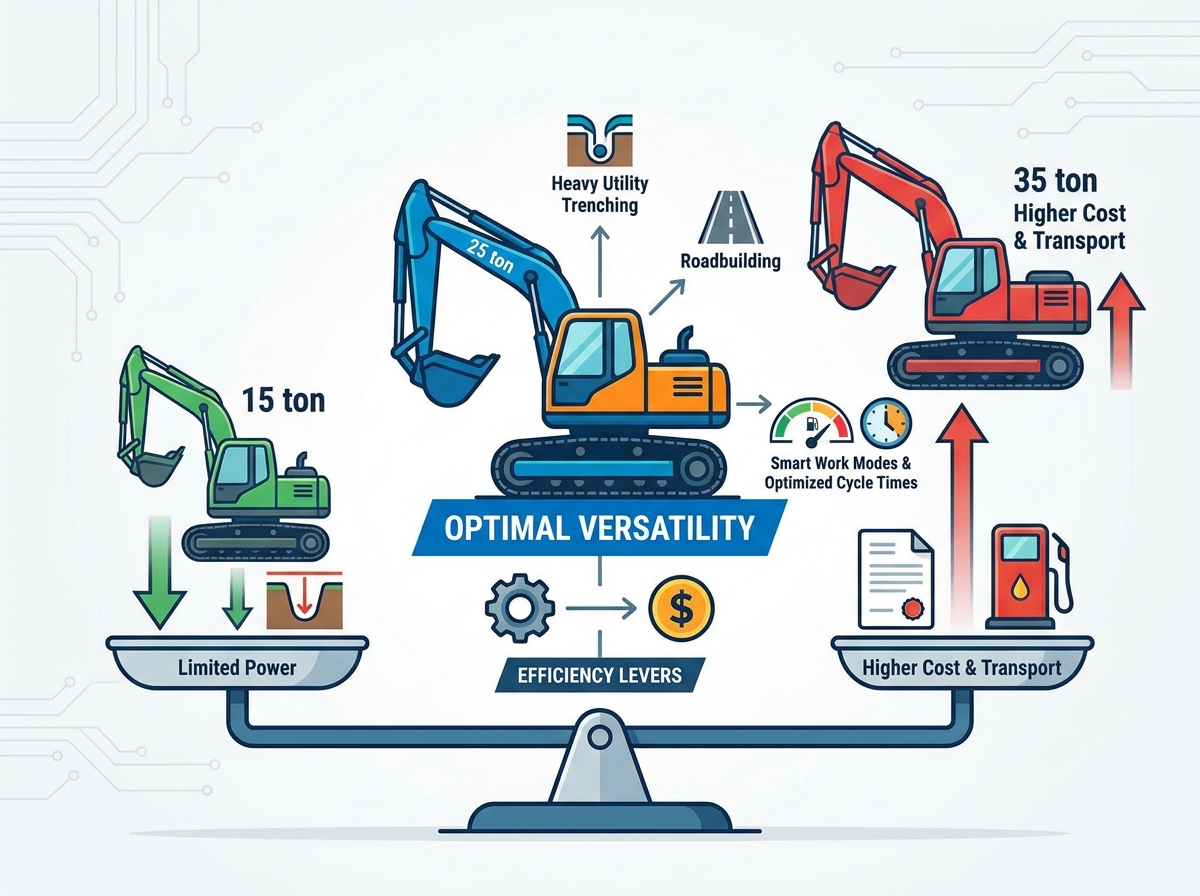
The 25-ton machine class represents the definitive sweet spot in heavy construction equipment today. These machines offer a critical balance on modern job sites. They deliver high-yield breakout force alongside logistical transportability. Many contractors face a difficult equipment dilemma during the procurement phase. Scaling up from 15-ton machines demands more raw digging power for demanding earthmoving tasks. Conversely, scaling down from 35-ton giants requires lower operating costs and easier access in tight urban environments. We designed this guide to clarify your procurement path. It provides a transparent, criteria-driven look at operational efficiencies and practical applications. We will also explore equipment economics and lifecycle expenses to support your final purchasing decisions. By understanding these core elements, you can maximize daily productivity while ensuring long-term profitability across varied terrains.
Optimal Versatility: 25-ton machines excel in heavy earthmoving, roadbuilding, and utility trenching without requiring specialized oversized transport permits.
Efficiency Levers: Maximizing ROI relies on strict adherence to operator training, intelligent use of machine work modes (Eco vs. Power), and optimized swing angles.
Financial Flexibility: Navigating the market for a 25 ton crawler excavator requires balancing upfront capital with long-term fuel efficiency, residual value, and attachment compatibility.
Used vs. New Market: Strategic sourcing of a used crawler excavator can reduce initial capital outlay by 30-40%, provided undercarriage and hydraulic health are rigorously vetted.
Contractors across the globe consistently rely on the 25-ton class for heavy-duty daily operations. This specific size category bridges the gap between nimble utility machines and massive earthmovers. It provides the exact performance metrics needed for diverse job sites.
Operating weights between 24,000 kg and 26,000 kg deliver exceptional stability. This weight-to-power ratio guarantees sufficient hydraulic flow for heavy attachments. You can easily run hydraulic breakers, shears, or large thumbs. Furthermore, the machine accomplishes this without exerting excessive ground pressure. Lower ground pressure prevents the excavator from bogging down in muddy or unstable terrain. It allows you to maintain continuous operation regardless of poor weather conditions.
Transport logistics heavily favor this weight class. Compliance becomes a major advantage for fleet managers. You can transport many 25-ton models on standard lowboy trailers. This eliminates the need to trigger costly, time-consuming oversized load escorts in most jurisdictions. Avoiding special permits saves thousands of dollars annually. It also enables rapid redeployment between different job sites within a single day.
Cycle time optimization further separates this class from heavier alternatives. Contrast the swing speed and agility of a 25 Ton Crawler Excavator against 30+ ton models. The 25-ton machine swings faster and recovers quicker. In repetitive truck-loading scenarios, these saved seconds compound rapidly. You achieve faster cycle times, which directly increases the total hourly tonnage moved.
Underground utility contractors frequently select 25-ton models for sewer and water projects. These machines boast deep dig capabilities required for municipal pipe replacements. They provide superior lifting capacity for maneuvering heavy concrete pipes into place. Operators can easily lift and position massive steel trench boxes. The stable footprint ensures safe operation even when working near the edge of a deep excavation.
Highway construction demands precision and spatial awareness. The 25-ton class integrates perfectly with standard articulating dump trucks (ADTs). Usually, four to five passes from a 25-ton bucket will comfortably fill a standard ADT. Space efficiency plays a vital role here. You can operate these machines effectively within standard single-lane closures. Larger machinery often requires shutting down multiple lanes, which increases traffic control costs and project complexity.
Demolition sites require durable equipment capable of handling extreme forces. This weight class provides excellent structural stability for handling high-impact attachments. You can confidently equip them with hydraulic breakers, concrete pulverizers, and rotating shears. The robust undercarriage absorbs the heavy vibrations generated during continuous concrete processing. They effectively tear down commercial structures while maintaining enough dexterity to sort recyclable materials.
Certain projects require specialty modifications. Long-reach booms transform standard excavators into specialized tools for deep dredging, slope grading, or waterway maintenance. A long-reach modification extends the digging envelope significantly. However, you must carefully address the trade-off in bucket capacity. Extended booms require smaller buckets to maintain safe lifting dynamics and prevent tipping. They remain indispensable for shaping steep embankments or clearing silt from drainage canals.
Buying the right equipment solves only half the productivity equation. Operating it efficiently determines your actual profitability. Implement these proven operational strategies to maximize daily yield.
Intelligent work modes represent your first line of defense against fuel waste. Original Equipment Manufacturers (OEMs) design specific engine settings for different tasks. You must break down the application of these settings. Eco mode reduces engine RPMs and prioritizes fuel economy during light grading or cleanup. Standard mode balances power and efficiency for general trenching. Power or Heavy mode maximizes hydraulic flow for heavy clay extraction or hard rock digging. Using Power mode for light cleanup burns unnecessary fuel and accelerates engine wear.
The 45-to-90 degree rule constitutes a fundamental operational best practice. You should always position dump trucks at a 45° to 90° angle to the trench. This specific geometry minimizes swing times. Swinging 180 degrees wastes valuable seconds on every single pass. By reducing the swing angle, you maximize hourly tonnage and reduce operator fatigue. Over a full shift, this positioning strategy can yield dozens of extra loaded trucks.
Telematics technology provides objective data to refine these practices. You should frame telematics as a mandatory evaluation requirement. Industry data shows tracking idle time and operator behavior directly reduces carbon emissions. It also lowers fuel costs significantly. Many machines spend up to 30% of their operational hours simply idling. Utilizing telematics alerts helps you enforce shut-down protocols, preserving warranty hours and saving money.
Table: Work Mode Application Guide
Work Mode | Engine RPM Profile | Ideal Applications | Fuel Consumption Impact |
|---|---|---|---|
Eco Mode | Low to Medium | Light grading, finishing, site cleanup | Saves up to 15% fuel |
Standard Mode | Medium to High | Utility trenching, truck loading, pipe laying | Baseline fuel usage |
Heavy / Power Mode | Maximum Output | Rock breaking, heavy demolition, hard clay | Increases consumption by 10-20% |
Understanding the long-term financial impact of heavy equipment requires moving beyond the initial sticker shock. You must evaluate the holistic financial burden over the machine's entire lifespan.
Several underlying variables dictate base pricing across different brands. Engine tier compliance plays a massive role. Tier 4 Final or Stage V emissions systems add complex engineering costs. Advanced GPS and 3D grade-control technology also increase the initial investment. Furthermore, factory-installed auxiliary hydraulic plumbing for complex attachments will raise the baseline figure.
You must frame the crawler excavator price as merely one component of overall lifecycle expenses. Factor in warranty terms and expected fuel burn per hour. Consider the frequency and cost of preventive maintenance intervals. A cheaper machine might consume more fuel or require more frequent hydraulic fluid changes. These hidden costs quickly negate initial purchase savings.
When searching for a crawler excavator for sale, you face the classic debate between new and pre-owned equipment.
Purchasing new equipment offers distinct advantages. Emphasize the value of comprehensive factory warranties. New machines guarantee maximum uptime and integrate the latest fuel-efficiency technologies. Buyers can often leverage tax depreciation incentives to offset the higher capital outlay.
Conversely, exploring the pre-owned market offers significant financial flexibility. You must utilize a strict framework for evaluating a used crawler excavator. Rigorous vetting protects your investment from inherited mechanical failures.
Used Equipment Inspection Checklist:
Fluid Sampling: Always pull engine oil, hydraulic fluid, and coolant samples to check for internal metal wear.
Undercarriage Health: Measure sprockets, idlers, and chain wear. Undercarriage replacement represents a massive hidden cost.
Slew Ring Play: Check for excessive movement or grinding in the slew bearing during rotation.
Hydraulic Performance: Verify consistent hydraulic pump pressure under load to ensure optimal breakout force.
Structural Integrity: Inspect the boom and stick for non-factory welds, stress fractures, or excessive pin wear.
Finalizing your equipment choice requires a structured, logical approach. Do not let brand aesthetics or superficial features distract you from core operational needs.
Start by clearly defining success for your specific fleet. Recommend buyers define their primary application before finalizing specifications. If your schedule involves 80% trenching, prioritize fuel economy and bucket capacity. If you anticipate 80% hammer work, prioritize hydraulic cooling capacity and heavy-duty guarding. Tailor the machine strictly to the work it will perform most often.
Dealer support and parts availability must heavily influence your decision. Emphasize that the lowest purchase price is entirely negated if dealer proximity causes extended downtime. If a hydraulic pump fails, waiting three weeks for a proprietary part will cost you crucial project deadlines. Evaluate the local dealer's service response times, field technician availability, and on-shelf parts inventory.
Move forward systematically to secure the best machinery for your business.
Actionable Next Steps:
Request a multi-day on-site demo to evaluate operator comfort and real-world fuel burn.
Run a simulated lifecycle expense calculator with your local dealer to map out long-term financial realities.
Compare residual value curves across top-tier brands to understand future trade-in equity.
Review all available attachment combinations to ensure maximum fleet compatibility.
A 25-ton excavator consistently provides the best intersection of power, transportability, and multi-industry versatility. Whether you lay municipal utilities, grade highways, or process demolition debris, this weight class delivers reliable results. It strikes the perfect balance between raw breakout force and logistical efficiency. Procurement should always be based on a verifiable blend of application matching and operational efficiency data. Rely on rigorous lifecycle expense analysis rather than brand loyalty alone. By optimizing work modes, managing swing geometries, and prioritizing proactive maintenance, you secure a highly profitable asset for your heavy construction fleet.
A: The typical range falls between 4 to 6 gallons (15 to 22 liters) per hour. This variance depends heavily on the selected work mode, the material load factor, and overall operator efficiency. Heavy rock digging increases consumption, while light grading minimizes it.
A: Yes, they are generally transportable on standard lowboy trailers without requiring costly escorts. However, you must always verify local weight restrictions, specific trailer weights, and regional bridge laws to ensure strict compliance.
A: Well-maintained models from major OEMs can easily exceed 10,000 operating hours. However, expect major consumable costs along the way. Undercarriage replacements are typically required between 3,000 and 5,000 hours, depending heavily on the harshness of the terrain.


